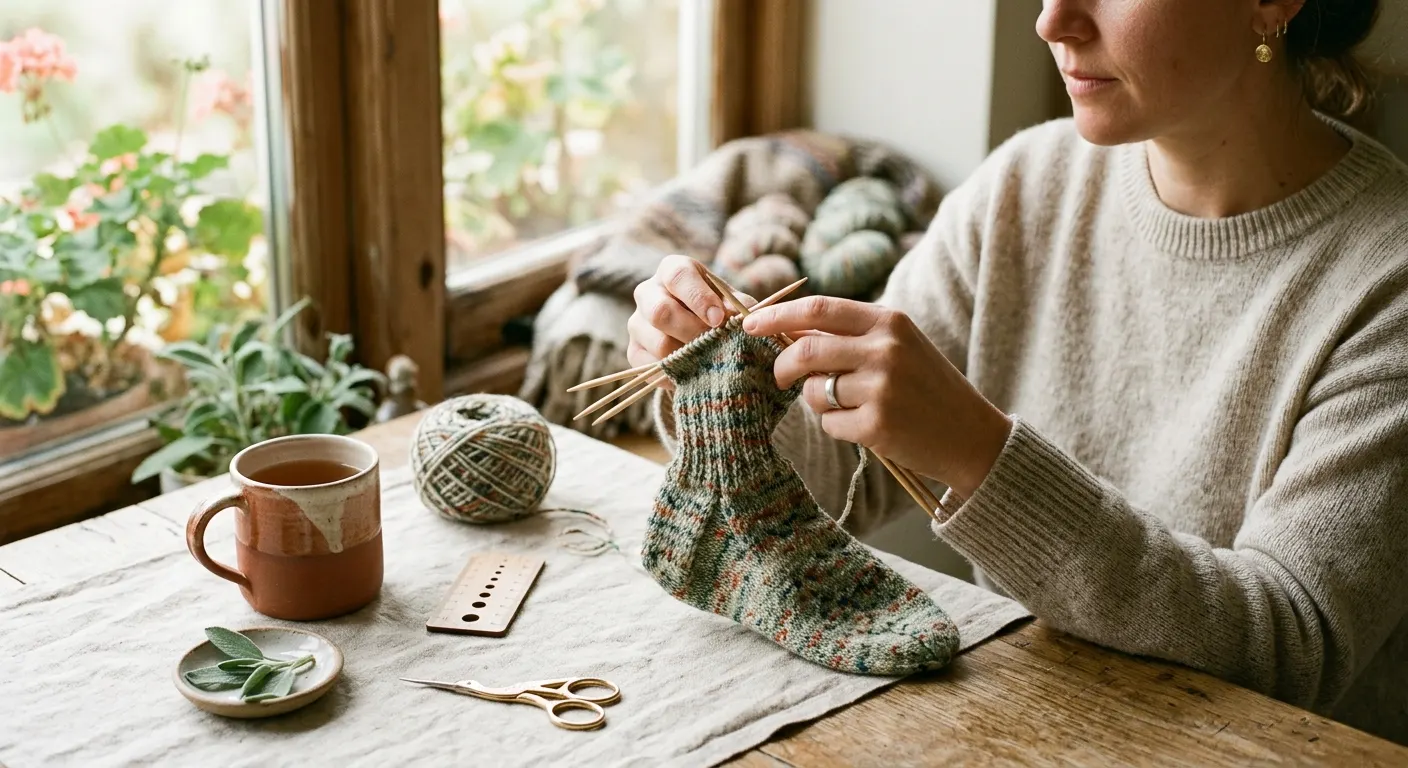
DPN Knitting for Socks: A Beginner Start-to-Finish Guide
By FiberCroft . 13 min read . Updated June 2026
Double-pointed needles are the traditional way to knit a sock, and they reward the learning curve with a tool that works well in tight spaces and gives a satisfying physical sense of the sock tube developing in your hands. The first time managing four or five needles at once feels awkward, but most knitters find that after the first inch of ribbing the technique becomes comfortable and the stray needles stop feeling like a liability. This guide covers which needles to use, how to set up stitches across four needles, and the steps through the cuff, heel flap, gusset, and toe, with specific tool recommendations like the Clover Takumi Bamboo Double-Pointed Needle Set (7-Inch) for beginners and the ChiaoGoo Stainless Steel Double-Pointed Needles for speed.
The short answer
Start your first sock on size US 1 or US 2 bamboo DPNs with a fingering-weight yarn. Cast on 60 to 72 stitches and distribute them across three needles, then use the fourth to knit. Clover Takumi bamboo DPNs are the best beginner choice because the slightly grippy surface keeps stitches from sliding off during setup. Work the cuff in ribbing, then the heel flap and turn, then gusset, foot, and toe decrease.
This guide contains affiliate links. FiberCroft may earn a commission at no cost to you.
Choosing your first DPN set
For a first pair of socks, bamboo DPNs in the sock-size range are the right choice. The Clover Takumi Bamboo Double-Pointed Needle Set (7-Inch) is the community default because the Takumi bamboo finish is smooth enough to let stitches move well while keeping enough grip to prevent them sliding off the needle accidentally. Dropping stitches off the end of a DPN is the most common beginner frustration in sock knitting, and a slightly grippy surface makes it significantly less likely.
The HiyaHiya Bamboo Double-Pointed Needle Set (Sock Sizes) covers the four most-used sock sizes in a single organized case. It costs more per needle than buying individual Clover Takumi sizes but gives you a complete sock-range kit in one purchase with a case to keep them together. Either approach works.
Experienced sock knitters often move to metal DPNs for speed. The ChiaoGoo Stainless Steel Double-Pointed Needles has the fastest stitch movement in the DPN category and tips sharp enough for fine lace-weight sock yarn. They are slippery for beginners but the right upgrade once you are comfortable with the DPN setup.

Clover Takumi Bamboo Double-Pointed Needle Set (7-Inch)
Ultra-smooth Takumi bamboo DPNs in a full set of common sizes. The community-standard recommendation for knitters learning sock and sleeve construction.
HiyaHiya Bamboo Double-Pointed Needle Set (Sock Sizes)
A targeted DPN set in the sock-range sizes US 0 through 3, well-finished bamboo tips in a travel-ready case. Sized for the most common sock yarn gauges.

ChiaoGoo Stainless Steel Double-Pointed Needles
Surgical-grade stainless steel DPNs with a polished finish and consistent sizing. The speed option for sock knitters who want stitches to move as fast as possible.
Setting up stitches on four needles
Most beginner sock patterns call for 60 to 72 stitches distributed across three needles in roughly equal groups, with the fourth needle used as the working needle. Cast all stitches onto one needle first, then slide the stitches onto three needles: needle one holds the first 20 (or 24), needle two the next 20, needle three the remaining 20. Arrange them in a triangle with the yarn tail at the right.
Before joining in the round, make sure no stitches are twisted around the needle shaft. Twisted cast-on is the most common setup error and shows up as a spiral that cannot be untwisted later. Lay the three needles flat and confirm all stitches sit with the cast-on edge toward the center before joining.
Join by knitting the first stitch of needle one with the working yarn from needle three, pulling the join snug. Place a ring marker or a locking stitch marker to mark the beginning of the round.

Clover Locking Stitch Markers (Set of 36)
Plastic locking markers in multiple colors that open and close reliably with one hand. The standard stitch marker recommendation for knitters and crocheters at all skill levels.
Cuff, leg, and tracking your rows
The cuff is worked in ribbing, typically k2p2 or k1p1, which gives the sock its elasticity at the ankle opening. The most common cuff length is 1 to 2 inches, worked for as many rounds as the pattern specifies. The KA Seeknit Clicker Row Counter Ring is the most convenient way to track these rounds because you wear it on your finger and advance it with a thumb press without setting down the needles.
After the cuff, the leg works in a stitch pattern of your choice, plain stockinette, ribbing continued, or a simple texture or lace repeat. Track rounds carefully, particularly if your pattern has a repeat that spans multiple rows. The Knit Picks Kacha-Kacha Tally Row Counter is a backup that works for row counting if you prefer a hand-held option.
Use a Knitter's Pride Platina Stitch Markers (Pack of 30 Ring) marker to mark the center of the needle opposite the beginning of round marker. This is useful during the heel setup, where you work back and forth on only half the stitches.

KA Seeknit Clicker Row Counter Ring
A ring-style row counter that slides onto your finger and advances with a thumb press. Available in multiple sizes and lets you count rows without ever setting down your knitting.

Knitter's Pride Platina Stitch Markers (Pack of 30 Ring)
Smooth, coilless plastic ring markers that sit on the needle between stitches. Lightweight and snag-free, in multiple sizes to suit different needle gauges.
Knit Picks Kacha-Kacha Tally Row Counter
A classic hand-held click-style tally counter that advances with a squeeze. Simple, reliable, and works for row counting, stitch counting, or any repeat tracking.
The heel flap and heel turn
At the heel, you stop working in the round and work back and forth on half the stitches, typically those on needle one. Slip the remaining stitches onto a single needle or stitch holder and set them aside: they become the instep stitches that wait while you work the heel flap.
The heel flap is worked in a slip-stitch pattern, typically slip 1, knit to end on right-side rows and slip 1, purl to end on wrong-side rows. This creates a reinforced fabric at the contact point of the heel. The flap length is typically the same number of rows as stitches on the heel needle, so a 30-stitch heel works about 30 rows.
The heel turn uses short rows to shape the curve of the heel. The exact row sequence is given in the pattern, and the mathematics work out so that you end with a small number of stitches remaining at the center of the heel ready to pick up gusset stitches along the flap edges.
Gusset, foot, and toe
After the heel turn, pick up stitches along both sides of the heel flap and rejoin the instep stitches in the round. The gusset creates a wedge that adds stitches on either side of the foot, which is then decreased over the following rounds back to the original stitch count. The decrease markers sit where the gusset meets the instep stitches.
The foot is worked plain in stockinette or in the instep pattern until the sock measures from heel to the base of the big toe, typically 2 inches shorter than the foot's total length. The toe is then decreased in a standard star or wedge shape to about 12 to 16 stitches, which are then grafted together with Kitchener stitch to close the toe seamlessly.
A small ruler or gauge tool in your project bag is useful for measuring foot length during the foot section. Stopping at exactly the right point before the toe prevents a sock that is too short or too long.
Clover Swatch Ruler and Needle Gauge Tool
A combined swatch ruler and needle gauge with L-shaped edges for measuring stitch gauge accurately and labeled holes for confirming needle size. A small essential for every knitting bag.
Featured in this guide
Clover Takumi Bamboo Double-Pointed Needle Set (7-Inch)
Ultra-smooth Takumi bamboo DPNs in a full set of common sizes. The community-standard recommendation for knitters learning sock and sleeve construction.
ChiaoGoo Stainless Steel Double-Pointed Needles
Surgical-grade stainless steel DPNs with a polished finish and consistent sizing. The speed option for sock knitters who want stitches to move as fast as possible.
HiyaHiya Bamboo Double-Pointed Needle Set (Sock Sizes)
A targeted DPN set in the sock-range sizes US 0 through 3, well-finished bamboo tips in a travel-ready case. Sized for the most common sock yarn gauges.
Clover Locking Stitch Markers (Set of 36)
Plastic locking markers in multiple colors that open and close reliably with one hand. The standard stitch marker recommendation for knitters and crocheters at all skill levels.
KA Seeknit Clicker Row Counter Ring
A ring-style row counter that slides onto your finger and advances with a thumb press. Available in multiple sizes and lets you count rows without ever setting down your knitting.

Lantern Moon Drawstring Project Bag (Small)
A small Vietnamese silk-cotton drawstring bag with a wide opening for easy access. The travel and commute favorite for sock projects and one-skein projects.
Related roundups
FAQ
Frequently asked questions
Is magic loop better than DPNs for sock knitting?+
Neither is objectively better. DPNs give a more tactile, compact feel and suit knitters who like managing a small amount of needles. Magic loop on a long circular needle uses one needle throughout and can feel more streamlined once the technique is learned. Most knitters try both and settle on whichever feels more natural. DPNs are worth learning first because they build an understanding of the sock tube structure that makes magic loop easier to understand later.
What size DPNs do I need for socks?+
Most fingering-weight sock yarn patterns call for US 1 or US 2 needles, which are 2.25mm and 2.75mm respectively. Check your pattern for the specified size and then swatch to confirm your gauge matches. Individual knitters vary enough in tension that you may need to go up or down a size from the pattern recommendation to hit gauge. The KA Seeknit and Clover Takumi sets both cover the US 0 to 3 range that covers sock knitting.
How do I avoid a ladder between DPN needles?+
Laddering, where a column of loose stitches forms at each needle join, happens when the first stitch on a new needle is pulled too loosely. The fix is to knit the first two stitches of each needle slightly more firmly than the rest, and also to rotate which needle the join falls on every couple of rounds so the ladder cannot reinforce itself in the same spot. Some knitters also use four needles with stitches distributed unevenly so the joins do not align from round to round.